

Book
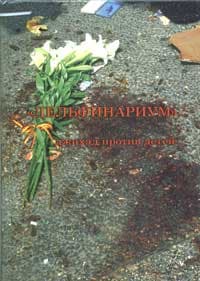
Dedicated
To the memory of those killed in the terrorist attack near the Tel Aviv Dolphinarium discotheque on June 1, 2001:
- Maria Tagiltseva - 14
- Evgenia Dorfman - 15
- Raisa Nemirovskaya - 15
- Yulia Sklyanik - 15
- Anna Kazachkova - 15
- Katerin Castañada - 15
- Irina Nepomnyashchaya - 16
- Maryana Medvedenko - 16
- Liana Saakyan - 16
- Marina Berkovskaya - 17
- Simona Rudina - 17
- Yulia Nalimova - 16
- Elena Nalimova - 18
- Irina Osadchaya - 18
- Alexey Lupalo - 17
- Ilya Gutman - 19
- Sergey Panchenko - 20
- Roman Dzhanashvili - 21
- Diaz Nurmanov - 21
- Yan Blom - 25 years old
- Uri Shahar - 32 years old
From the Publisher
Since the beginning of Intifada Two, terror has been an everyday phenomenon in Israel.
So — why this book on Dolphinarium?
It is important because this is the first focused terrorist act — aimed specifically at a given community. And specifically at children. Those who sent the suicide bomber had not picked the target at random: they knew that Friday nights the disco was a gathering place for “Russian” children.
Hence, their task was to intimidate the Russian community — to force Russian Jews to stay in Russia.
To stop the aliya.
As you read this book — the testimony of the parents who lost their children and of the children themselves, maimed by the bombing — you will see that the terror has, in fact, achieved the result opposite to the one intended. Now the “Russians” are not leaving; now it is the blood of their children that ties them to the land of their forefathers.
The survivors of the bombing are so young — and they have already encountered death. Yet they are dedicated to pursuing their lives; they are determined to combat evil and prevent the triumph of terror. They refuse to let fear fill their hearts; they refuse to buckle down, to give up their dreams and their principles. This modest heroism deserves to be known.
The testimony in this book will break your heart. But it will also instill confidence: terror will not prevail, either in Israel or in the United States, or elsewhere. Ordinary people, devastated by the grief of losing their children are more powerful than the fanatics who blow themselves up for the sake of the “paradise” they have been promised.
Solidarity rooted in grief is more powerful than one rooted in faith. People joined in their humanity — basic moral laws that proscribe deliberate murder of the innocent — will triumph over the madmen who betrayed humanity for the sake of their ideology.
The will to live is more powerful than the will to kill. This is why we will win.
Mikhail Chernoy
From the Editors
The editor of this book once worked in the archives of Yad Vashem, the Holocaust memorial in Jerusalem. After completing this work, she said: “Yad Vashem is an ocean of suffering. The Dolphinarium is a single cup drawn from that ocean.”
This cup of pain should be seen and understood by all nations — not as a matter of blame, but as a shared human responsibility.
The Holocaust became a warning to humanity about what can happen when hatred, ideology, and indifference go unchecked. The deaths of children in acts of terror today are another reminder that violence against civilians remains a global moral failure.
Time and again, innocent people become the first victims of cycles of hatred — hatred that strips away what is human and justifies violence in the name of ideas.
If these words feel distant or abstract, look at the consequences. Read these pages.
They contain the stories of children whose lives were taken, and of those who survived. They contain the voices of parents who continue to live with loss, and of young people who carry the memory of that night.
These are not distant events in history, but experiences of our time — in an age of global media and constant information.
Read. Reflect. Do not remain indifferent.
Because when violence against civilians is ignored, it does not remain isolated. It grows, spreads, and repeats itself in new places and new forms.